FAMILY THERAPY RETURNS TO SPENEX
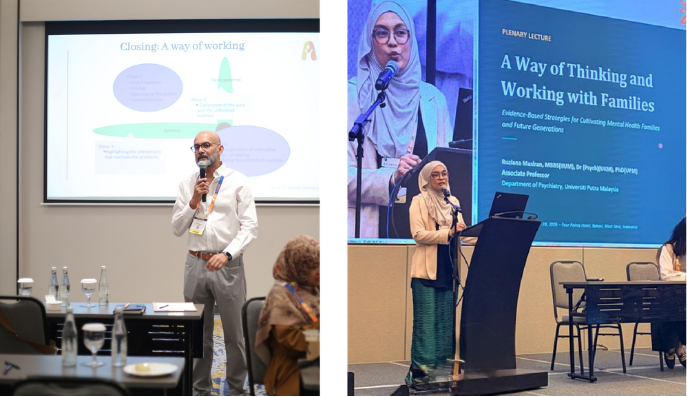
Darrel Devan Lourdes Managing Director of Andolfi Family Therapy Centre (AFTC) & Associate Professor Dr. Ruziana Masiran of Universiti Putra Malaysia (UPM)
Now in its sixth edition, the Special Education and Neuropsychiatry Expo and Scientific Meeting (SPENEX) has become one of Indonesia's leading interdisciplinary conferences in special education, mental health, psychiatry, psychology, and neuroscience.
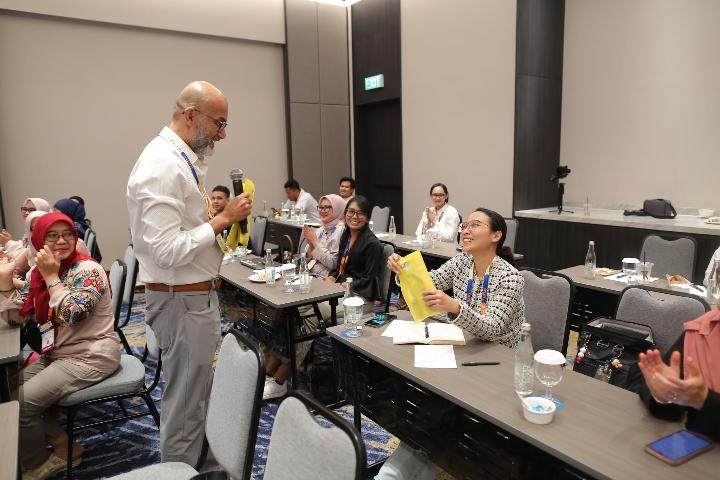
Following the success of their participation in SPENEX 2025, Darrel Devan Lourdes and Associate Professor Dr. Ruziana Masiran of Universiti Putra Malaysia (UPM), were invited to return to the conference after their live family therapy demonstration and experiential teaching seminar received an overwhelmingly positive response. This year’s workshop brought together approximately 40 teachers, counsellors, psychologists, psychiatrists, and other mental health professionals.
DEMONSTRATING THE POWER OF MULTIGENERATIONAL FAMILY THERAPY
On 17 July, a live family therapy session was conducted by Darrel with a family whose 13 year-old daughter had been diagnosed with Major Depressive Disorder (MDD). She had been engaging in self-harming behaviours through cutting and had persistently refused to attend school. The live session was professionally recorded, allowing participants to observe the therapy process in real time.
On 18 July, the recording became the foundation for an in-depth teaching workshop led by Darrel and Dr. Ruziana, where participants examined the therapist's interventions, clinical reasoning, and formulation throughout the session. Rather than viewing the young girl's symptoms solely as individual pathology, participants witnessed how Professor Andolfi's multigenerational approach seeks to understand the child within the context of the family's emotional system. The workshop illustrated several of Andolfi's central principles, including:
- Working through the child to understand the wider family system.
- Exploring intergenerational patterns that continue to shape present relationships.
- Understanding the impact of unresolved marital conflict on children's emotional wellbeing.
- Recognising children as valuable relational resources whose voices often reveal the hidden emotional realities within a family.
As the therapy unfolded, the girl's self harming behaviour gradually acquired a new relational meaning. Through careful exploration of the family's history, it became evident that her distress had begun around the age of eight, coinciding with increasing tension and conflict within her parents' marriage. Although deeply affected by the emotional climate at home, she recognised that her parents were already struggling and felt unable to burden them further with her own pain.
Unable to express her fears and loneliness, she increasingly withdrew into isolation, spending long periods online while distancing herself emotionally from those around her. Over time, her emotional suffering found expression through self-harming behaviours, which came to represent not simply symptoms of depression but an attempt to manage overwhelming emotional pain that had never found a safe relational space to be heard.
A RELATIONAL UNDERSTANDING OF CHILDREN’S DISTRESS
CLINICAL REFLECTION
For many participants, this represented a significant shift in clinical thinking—from asking, "What is wrong with this child?" to asking, "What has happened within this family's relationships that gives meaning to this child's distress?"
The workshop concluded with many participants expressing that the live case had fundamentally changed how they understood children's symptoms and family relationships. Strong interest was shown in further professional development in multigenerational family therapy.
Darrel and Ruziana are grateful for the opportunity to continue this collaboration with SPENEX and hope it will encourage more professionals to adopt a relational perspective—one that sees families as a central resource in understanding distress and fostering lasting therapeutic change.